

As AI takes over services, who keeps the gain?
Written by Itay Inbar and Jason Cohen
Eighteen months ago, we asked ourselves a question: how do you capture value and win big in vertical AI? When two people and Claude can plausibly build a billion-dollar company, the underlying technology is no longer an enduring moat. The edge lies instead in product depth, vertical workflow, proprietary data, and distribution, turning a general-purpose model into something users trust and adopt.
An emerging thesis around AI in services takes this logic one step further. If AI can do the core work, why sell software to the people doing it? Own and deliver the outcome instead. Don’t just serve accountants better, become the accounting firm. As AI infiltrates the multi-trillion-dollar services economy, many AI-native companies have begun doing exactly this, and with real success across accounting, law, healthcare, property management, and more.
We think this logic is right but incomplete. Owning the work is not the same as keeping the gain. Automation has made the work cheaper many times in history, and the savings almost always end up with the customer, rather than the operator. The real question is not whether AI can do the job, but what remains scarce once it can: a license a competitor cannot obtain, a track record that cannot be replicated, an obligation that cannot be delegated elsewhere. By understanding unique characteristics of an industry, you can determine the best strategy for a new entrant to take share and succeed.
Value Creation ≠ Value Capture
In the early 1800s, an English chemist named John Walker scraped a coated stick against a rough surface to clean it. The stick burst into flames. He had discovered the first commercially successful friction match. Walker began selling these matches locally, but refused to secure a patent, saying “I doubt not it will be a benefit to the public, so let them have it.” Competitors copied and improved on his design, and within years, Walker was forced out of the market by intense competition. He was right about the public benefit: matches spread across the world. But with no structural advantage, he never built the business that would let him share in it.
For as long as markets have existed, innovation has created far more value for the world than for the people who have introduced it. William Nordhaus, a Nobel Prize-winning economist at Yale University, tried to measure this effect directly. Using data from 1948-2001, he estimated that roughly 2% of the value generated by innovation is captured by the innovators themselves. The other 98% flows to everyone else: customers, workers, suppliers, and the broader economy. For every dollar of value innovation created, the innovator kept about two cents.
This same mechanism is at work today, but faster. As AI lowers the cost of doing work, increased competition will, on average, push most of the gain towards customers through lower prices, faster delivery, and better services. Sharing in the gain is possible, and it is decided not by the quality of the idea, but by how a business approaches the market. Capturing it requires answering two questions in order: how much of the work can AI actually do, and who keeps the gain?
How much can AI actually do?
AI-driven efficiency gains in services will be massive. In our 2024 piece, we identified roughly 50 million knowledge workers – with wages amounting to $3.8 trillion – as being at risk of AI disruption. However, the impact will not be uniform across industries.
Software reshaped entire industries over the past 20 years but hit a ceiling at a certain level of complexity. AI has pushed that ceiling much further.
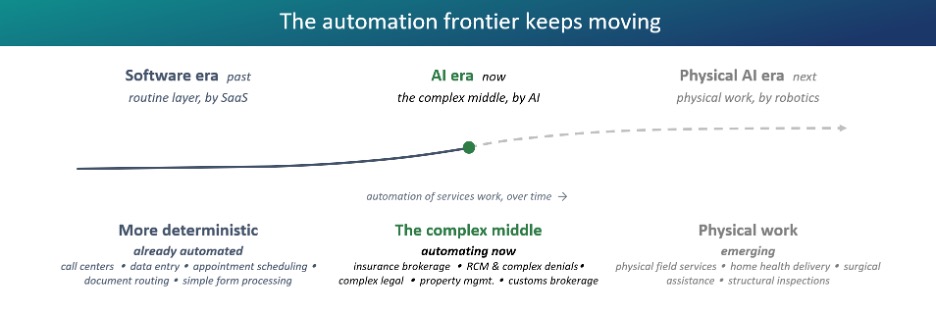
The efficiency gains created by software were massive, but competitive pressures meant the gain was split between customers and a handful of industry winners. With AI, the same is bound to happen. In call centers, a wave of well-funded AI entrants has driven the price per resolved call down dramatically within a couple years. The customers, not the vendors, have been keeping most of those savings.
Who keeps the gain?
Assume automation is free and universal tomorrow, with each competitor holding the same technology. What stops a customer from switching, a newcomer from undercutting you, or the client from bringing the work in-house?
If the honest answer is “nothing”, then it is hard for an incumbent to keep the gain. It will pass to customers as lower prices, and the more automatable the work, the faster this happens. If the answer is “they legally can’t” or “leaving carries too high a cost”, then something structural is holding that gain in place.
This structure is deeper than a moat: it’s a control point, the reason the customer keeps going through you even after AI has made the underlying task cheaper and easier to produce. This is not a new idea, and we saw the same evolution with software. What changes with AI is the speed at which the work commoditizes, and therefore how quickly a weak control point gives way.
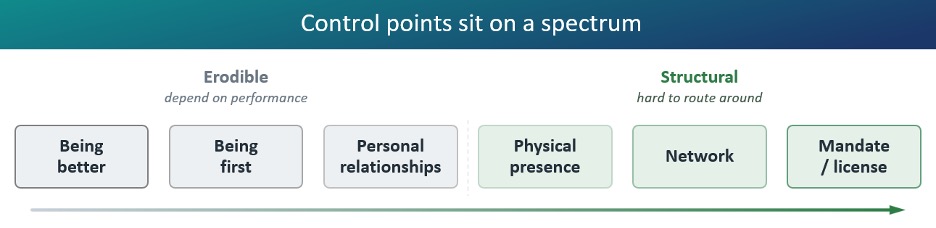
Control points sit on a spectrum from nearly unassailable to easily eroded. Where a business sits determines how much of the AI efficiency gain it can hold. Critically, an industry with strong control points is not “better”, but harder to disrupt and more favorable to incumbents. The control point strength simply indicates what approach should be taken by a new entrant. The categories below are ones we see most often.
At the durable end are the structural control points:
- A mandate or license: a law, a contract, a regulator, or a counterparty requires the operator's involvement, or limits who may do the work on someone else's behalf.
- A network: the product is more valuable because everyone else is already there, so no single customer can leave without losing access to the rest.
- Physical presence: being in the middle of a physical workflow is hard for disruptors to replicate, and more expensive to switch out of.
At the erodible end are the control points that depend on continued performance:
Being better: many great businesses simply out-execute the competition, but AI bridges the gap significantly.
Being first: a head start builds scale, but it has to be converted into something structural before it decays.
Relationships: personal rapport is portable. People leave and buyers change roles, and a capable model increasingly imitates responsiveness and judgment.
- Caveat: institutional trust, earned through verified outcomes, liability, and counterparty acceptance, is far more durable
The practical implication is that a weaker control point is at risk of getting competed away. However, weaker control points can be stacked into something that does hold. Bloomberg, for example, is not durable because of some legal requirement. On day 1, there was nothing. It’s strength comes from a network, a habit, and a physical presence in the workflow that was built over time and would be expensive to replace. The MLS survived Zillow the same way: timely data, broker cooperation, and daily workflow wound together.
Mapping the gain
Putting the two questions together, we have a framework for where every services industry lands. The x-axis is automatability, the share of the work a capable model can do end-to-end. This determines how much of the core work AI can take, which sets the size of the prize. The y-axis is control point strength, which decides who keeps the gain.
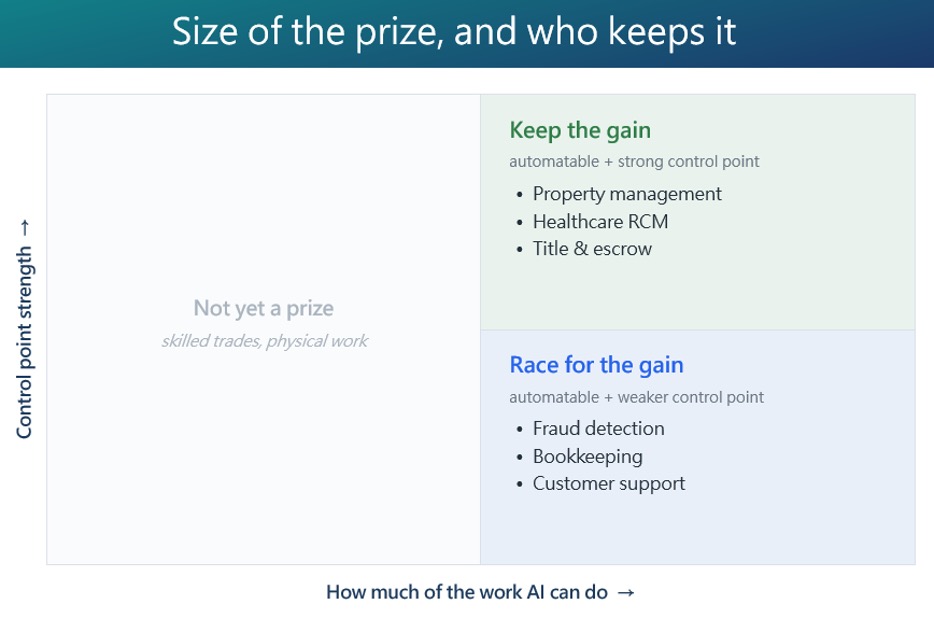
The upper right is where the work is highly automatable and the control point is strong. This is where the operator can keep a meaningful share of the savings, but it is more difficult to displace incumbents. Take long-term property management as an example:
- The work: labor intensive today, but highly automatable (leasing paperwork, tenant communication, arrears chasing, vendor coordination, and financial reporting).
- The control point: the management contract, physical presence, local operational knowledge and execution, accumulated trust.
- Verdict: creating more efficiency while retaining the control point means the owner can keep more of the gain.
The lower right is highly automatable, with a weaker control point. This is where the largest greenfield opportunities are. Incumbents sit unprotected, so AI-native operators can take the market outright rather than chipping at pieces of it. The caveat: the same openness that lets you in lets the next entrant in too. Take customer support:
The work: labor intensive, but highly automatable and increasingly AI-native (deflecting and resolving routine tickets, drafting responses, summarizing cases, escalating).
The control point: being better at the work through resolution rate, speed, and trust. The enterprise you’re serving owns the customer, the brand, and the system of record the conversation runs through.
Verdict: the winners in this industry will build early leads that compound over time and can harden into stronger, more defensible control points.
- One way to do this: acquire a BPO and do more of the work yourself. Crescendo acquired PartnerHero in 2024 to own the work itself, rather than selling software into an incumbent.
As technology improves, industries move to the right of the graph: work that resisted automation, like physical field services, will undergo the same transformation, with the control point again deciding who keeps the gain.
Adapt to your control point
We see three primary ways that startups are approaching these industries: buy the operator (roll-up), build the operator (AI-native), and arm the operator (application).
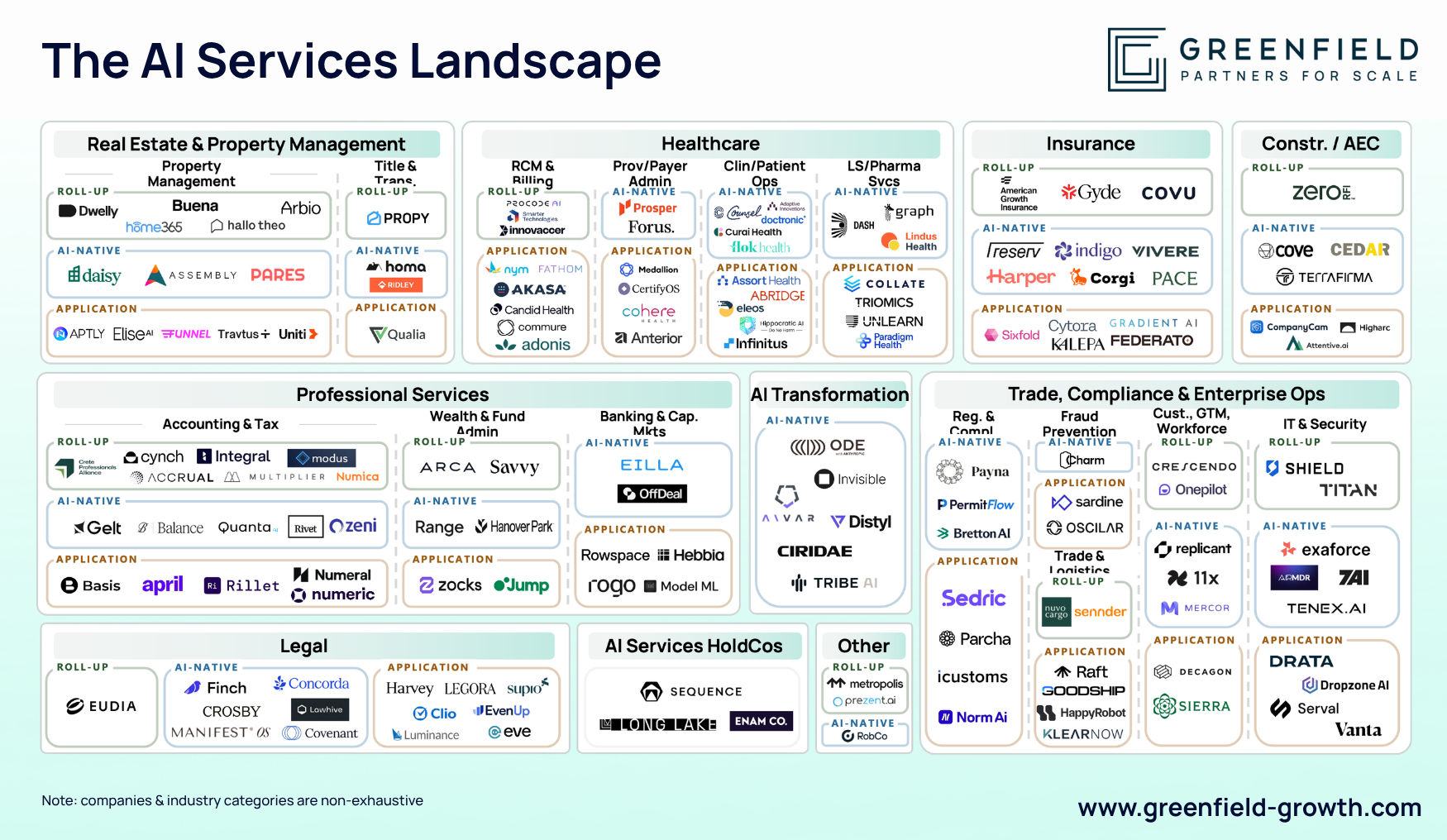
The right approach follows directly from the industry’s control point.
- Buy the operator: when the control point is strong but scattered across many small incumbents, building from scratch is hard. A fragmented field of small licensed or mandated operators is precisely what can be consolidated: buy the operator that already holds the customer, embed AI to improve efficiency, and the businesses that traded at a services multiple begin to compound like a platform. The value you acquire is in the license, contracts, and relationships that stay with the business rather than leaving with the seller, the way Dwelly is acquiring directly to build a letting agency empire.
- Build the operator: when the control point is weak, incumbents are exposed to disruption from a faster, better new entrant. Instead of selling software to incumbents or acquiring expensive revenue, go around them and directly to the end customer. Harper is an example of a business having success going direct as an AI-native insurance broker, rather than simply selling the tools.
- Arm the operator: when the control point is strong and consolidated, selling the incumbents the tools beats fighting them. Harvey is taking this approach with law firms, selling into the established players rather than replacing them. The brand reputation, partner relationships, and licenses remain with the incumbents, but scale is attainable quickly and product features can be deepened as they increasingly become a core, irreplaceable part of the workflow.
The three motions are not arbitrary; they follow an inverse relationship where control point strength tends to run opposite to how aggressively an industry’s incumbents adopt AI. Where the control point is strong, incumbents feel safe and invest slowly. Where the control point is weak, incumbents recognize their exposure and race to adopt any incremental improvement that can sustain their position, even if it means a rebrand or a pivot. In these markets, the attacker’s advantage is speed and execution, with the prize going to whoever can compound their lead into a control point first.
Implications
AI is leveling the playing field in services. The winners will be companies that own something that a competitor with an identical model cannot take or replicate. If the answer is that something is a license, a network, or trust that has hardened into the workflow, the gain endures and may be worth paying up for. If the answer is that the company is first and best, the prize is potentially huge, but must be earned every day. Automation is the price of admission in services now. It was never the moat.
At Greenfield, we are actively looking to back the companies implementing AI into services across each approach. We've backed Exodigo, which maps the underground without digging and acquired a civil engineering firm to certify what it finds; Torq, whose agents run security operations across every major platform's telemetry rather than one vendor's; GoodShip, which is building out a two-sided network in freight; and Eleos, which moved from documenting the session to owning the compliance and reimbursement layer in behavioral health. Each is doing the harder thing: not just automating the work but building the position that lets them keep the gain from doing so while delivering more value to their customers. If you are buying, building, or arming your way into one of these positions, we would like to hear from you.